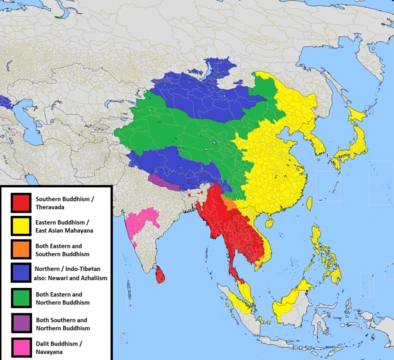
Hinayana
A contested term for early Buddhist paths to liberation.

Hīnayāna, a Sanskrit term meaning 'Small Vehicle' or 'Lesser Vehicle', is an umbrella term used by the Mahāyāna school to refer to the pre-Mahāyāna Buddhist paths to liberation, specifically the Śrāvakayāna ('Listeners Vehicle') and Pratyekabuddhayāna ('Solitary-Realizers Vehicle'). The term is considered derogatory and polemical by modern scholarship, which prefers the term Nikāya for the early Buddhist schools. It has also been inappropriately used as a synonym for the Theravāda school.
- field
- Buddhist studies
- known_for
- Umbrella term for early Buddhist schools, contrasted with Mahāyāna
- etymology
- From Sanskrit hīna ('little', 'inferior') and yāna ('vehicle')
Lore & Background
The term Hīnayāna is formed from the adjective hīna, meaning 'little', 'poor', 'inferior', 'abandoned', 'deficient', or 'defective', and the noun yāna, meaning 'vehicle' or 'path' to enlightenment. The Pāli Text Society's dictionary defines hīna in even stronger terms, including 'poor, miserable; vile, base, abject, contemptible', and 'despicable'. The term was translated into Classical Chinese as 'small vehicle' by Kumārajīva and others, and into Mongolian as Baga Holgon, also meaning 'small' or 'lesser' vehicle. In Classical Tibetan, there are at least two words: theg chung ('small vehicle') and theg dman ('inferior vehicle' or 'inferior spiritual approach').
Reader's Guide
According to Jan Nattier, the term Hīnayāna most likely postdates the term Mahāyāna and was created as a back-formation due to antagonism between proponents of the Bodhisattva and Arhat ideals. The earliest Mahāyāna texts often use Mahāyāna as an epithet for Bodhisattvayāna, but Hīnayāna is comparatively rare and not found in the earliest translations. Paul Williams notes that the common perception of fierce criticism of the Lesser Vehicle by Mahāyāna is not supported by texts, and evidence shows peaceful coexistence between the two traditions. The seventh-century Chinese monk Yijing wrote that there was no simple correspondence between a Buddhist school and whether its members learned Hīnayāna or Mahāyāna teachings; the term referred to individuals based on doctrinal differences. Scholar Isabelle Onians asserts that the term Śrāvakayāna was the more politically correct and much more usual term used by Mahāyānists. Jonathan Silk argues that 'Hinayana' was used to refer to whomever one wanted to criticize on any given occasion, not to any definite grouping of Buddhists.
Did You Know?
- The term Hīnayāna is formed from hīna ('little', 'inferior') and yāna ('vehicle').
- Modern Buddhist scholarship deprecates the term as derogatory and polemical, preferring Nikāya.
- The seventh-century Chinese monk Yijing wrote that there was no simple correspondence between a Buddhist school and whether its members learned Hīnayāna or Mahāyāna teachings.
- According to Jan Nattier, the term Hīnayāna was created as a back-formation after the term Mahāyāna was already established.
More in Buddhist Traditions 1-21
Spotted an error? Know more?
This is a living reference — every entry is fact-audited, and reader corrections feed straight into our audit queue. Suggest an edit · See this site's audit record