Buddhist monasticism
One of the earliest surviving forms of organized monasticism.

Buddhist monasticism is one of the earliest surviving forms of organized monasticism and a fundamental institution of Buddhism. Monks (bhikkhu) and nuns (bhikkhuni) are responsible for preserving and disseminating the Buddha's teaching and guiding lay followers. Three surviving traditions of monastic discipline—Theravada, Dharmaguptaka, and Mulasarvastivada—govern modern monastic life in different regions.
- founded_by
- Gautama Buddha
- period
- 5th–4th century BCE
- traditions
- Theravada, Dharmaguptaka, Mulasarvastivada
- monks_called
- bhikkhu (Pali), bhikshu (Sanskrit)
- nuns_called
- bhikkhuni (Pali), bhikshuni (Sanskrit)
- key_text
- Vinaya (monastic discipline)
- ordination_stages
- Samanera (novice) and Upasampada (higher ordination)
Lore & Background
Buddhist monasticism originated as a renunciant tradition practiced by ascetics who had left lay life. According to tradition, the order was founded by Gautama Buddha during his lifetime when he accepted a group of fellow renunciants as followers. The lifestyle grew out of earlier sects of wandering ascetics, some of whom the Buddha had studied under. Monks and nuns were dependent on the lay community for food and clothing, and in return guided lay followers on the path of Dharma. Early monastics traveled in small groups, living on the outskirts of communities and meditating in forests, with minimal possessions provided by lay supporters.
Reader's Guide
Buddhist monasticism is significant as a foundational institution that preserved and transmitted Buddhist doctrine and discipline for over two millennia. Its three surviving Vinaya traditions—Theravada, Dharmaguptaka, and Mulasarvastivada—continue to govern monastic life in Southeast Asia, East Asia, and the Himalayan region respectively. Monastics serve as a 'field of merit' for lay followers, who earn merit by providing material support, while monks and nuns focus on study, meditation, and moral conduct. The tradition's adaptability is evident in its spread from India to become a pan-Asian phenomenon and later to Western countries. The decline of the bhikkhuni lineage in Theravada and Vajrayana regions, and ongoing efforts to revive it, highlight debates about gender and institutional recognition. The two-stage ordination process (novice and higher ordination) and varying rule counts across traditions reflect both unity and diversity within Buddhist monasticism. Its legacy includes the development of large monastic universities and the continued practice of temporary ordination in Southeast Asia.
Did You Know?
- The order of monks and nuns was founded by Gautama Buddha during his lifetime.
- Three surviving Vinaya traditions govern monastic life: Theravada, Dharmaguptaka, and Mulasarvastivada.
- The Theravada lineage of bhikkhunis died out between the 11th and 14th centuries.
- Monks and nuns are expected to live with a minimum of possessions, voluntarily provided by the lay community.
Origins in the Indian Subcontinent
The earliest Buddhist community took shape in the northeastern Indian subcontinent between the 6th and 4th centuries BCE, a period marked by social upheaval, growing urbanization, and vigorous philosophical inquiry. The Buddha, born into the Shakya clan, drew a remarkably diverse circle of adherents—clan members, merchants, peasants, and wandering ascetics—who were attracted to his teachings as an alternative to the ritualistic and hierarchical religious traditions of the era. These first followers embraced foundational doctrines including the Middle Way, the Four Noble Truths, and the Noble Eightfold Path. Notably, they did not call themselves Buddhists; that English label would not appear until 1810. Instead, early Indian practitioners were identified as Sramanas, a term foregrounding their dedication to renunciation, ethical conduct, and meditative practice. Following the Buddha's death, the community structured itself around viharas, and a person's standing within the tradition became closely linked to observance of the Vinaya monastic code and the Pāli Canon or Sanskrit scriptures.
Monastic Structure and the Saṅgha
Buddhist monasticism rests on a clear structural distinction between ordained practitioners and lay devotees. The ordained monastics—Bhikkhus and Bhikkhunīs—constitute the Saṅgha, the monastic community that functions as the primary custodian and transmitter of the Buddha's teachings, serving as religious teachers across generations. In contrast, Upāsakas and Upāsikās are lay followers who maintain household lives while supporting the monastic community and integrating Buddhist practice into everyday existence. This dual architecture means Buddhist identity is far from monolithic: it embraces those who have fully renounced worldly attachments as well as those who weave ethical principles, meditation, and mindfulness into ordinary life without any formal ritual affiliation. The Vinaya provides the regulatory discipline for ordained life, while the Pāli Canon and broader sutra collections anchor scriptural study. In early India, the emphasis on renunciation was so defining that practitioners were identified primarily as Sramanas—ascetics committed to ethical living—rather than by any sectarian or denominational label.
Geographic Spread and Cultural Integration
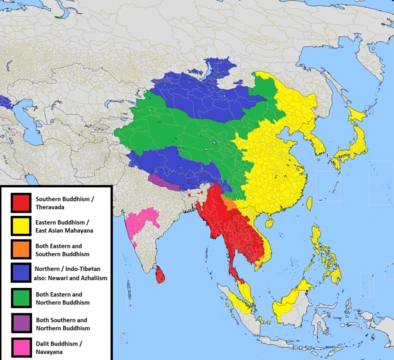
As Buddhism traveled along trade routes from its Indian origins into Central Asia, East Asia, and Southeast Asia, it absorbed and merged with local cultural frameworks, producing richly distinct regional identities. In China, Buddhist thought interwove with Confucian and Daoist philosophy, giving rise to Mahayana traditions that emphasize the Bodhisattva path and draw on a broad corpus of Mahayana sutras. In Tibet and the wider Himalayan region, Vajrayana practices became central, forging a religious identity that also carried significant cultural and political dimensions. In Southeast Asia, Theravāda Buddhism became so deeply intertwined with national identity in Thailand, Myanmar, and Sri Lanka that kings and governments historically patronized monasteries and promoted Buddhist moral values as pillars of social order. Local terminology reflected these adaptations: Fo-zu in China, Bukkyōsha in Japan, and Chos-pa in Tibetan communities. The two largest traditions today—Theravāda, dominant across Sri Lanka, Thailand, Myanmar, Cambodia, and Laos, and Mahayana, prevalent in China, Japan, Korea, and Vietnam—illustrate how a single Indian philosophical tradition diversified into multiple cultural expressions across the Asian continent.
Modern Demographics and Secular Influence
Today, roughly 320 million people worldwide identify as Buddhist, representing approximately four percent of the global population. Thailand holds the largest absolute share of this community, followed by China and Myanmar. Outside Buddhist-majority nations, sizable populations exist in India and the United States. Yet the demographic picture is shifting: in East Asia, Buddhism has experienced a decline in recent years, attributed to lower fertility rates and a broader rise in irreligion. Paradoxically, the tradition has simultaneously expanded its cultural and intellectual footprint in Western countries, driven largely by growing interest in meditation, mindfulness, and Buddhist ethical philosophy. Modern usage of the term Buddhist has broadened considerably, encompassing not only traditional monastic practitioners and lay devotees but also secular individuals who adopt aspects of Buddhist thought without participating in formal rituals or monastic life. This pluralistic identity—religious, cultural, or secular—reflects a tradition that has continuously adapted to new social contexts over more than two millennia of history.
Frequently Asked Questions
What is Buddhist monasticism and who set it up?
It is the organized community of ordained monks and nuns that Gautama Buddha established in the 5th–4th century BCE. It stands as one of the oldest surviving forms of structured religious community in the world.
What do Buddhist monks and nuns actually do day to day?
Bhikkhus (Pali for monks) and bhikkhunis (nuns) serve as the primary custodians and teachers of the Buddha's Dharma. Their core duties include preserving the teachings, maintaining the sangha, and offering spiritual guidance to lay followers.
Which three monastic discipline traditions are still active today?
The surviving lineages are Theravada, Dharmaguptaka, and Mulasarvastivada. Each governs monastic life in different regions of the modern Buddhist world, giving local communities their own disciplinary framework.
What is the governing rulebook for monastic life?
The Vinaya, meaning 'monastic discipline,' is the foundational text that codifies the code of conduct for both bhikkhus and bhikkhunis. It covers everything from daily routines and robes to the formal ordination process.
Why is Buddhist monasticism considered essential to the faith?
Without the monastic community there would be no institutional mechanism for preserving, transmitting, and teaching the Buddha's original teachings across generations. It functions as the living backbone that connects lay practitioners to the Dharma.
More in Buddhist Traditions 1-21
Spotted an error? Know more?
This is a living reference — every entry is fact-audited, and reader corrections feed straight into our audit queue. Suggest an edit · See this site's audit record