Chan Buddhism
A Mahāyāna tradition emphasizing meditation and direct insight into Buddha-nature.

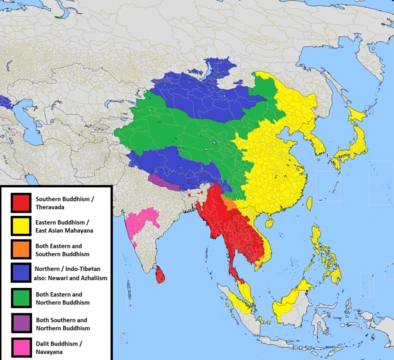
Chan (禪), a Mahāyāna Chinese Buddhist tradition, derives from the Sanskrit dhyāna, meaning 'meditation' or 'meditative state.' It developed in China from the 6th century CE onward, becoming especially popular during the Tang and Song dynasties, and by the Ming and Qing dynasties it was one of the most influential forms of Buddhism in China. Chan is the originating tradition of several schools in the Sinosphere, spreading as Thiền in Vietnam, Seon in Korea, and Zen in Japan.
- origin
- China, 6th century CE
- tradition
- Mahāyāna Buddhism
- key_practices
- Zuochan (sitting meditation), gong'an contemplation, huatou, nianfo
- influential_periods
- Tang and Song dynasties
- derived_schools
- Thiền (Vietnam), Seon (Korea), Zen (Japan)
- key_texts
- Laṅkāvatāra Sūtra, Śūraṅgama Sūtra, Platform Sutra, Blue Cliff Record
Lore & Background
Chan teaching draws from Sarvāstivāda meditation, Mahāyāna Bodhisattva path, Yogācāra, and Tathāgatagarbha (Buddha-nature) thought as taught in the Laṅkāvatāra Sūtra and the Śūraṅgama Sūtra, as well as the Huayan school. The Prajñāpāramitā literature and Madhyamaka thought have also shaped the apophatic and sometimes iconoclastic nature of Chan rhetoric. Key practices include zuochan (sitting meditation in lotus position), contemplation of gong'ans and huatous, and nianfo (chanting 'Namo Amituofo'). Monasteries also engage in chanting sutras and dharanis, taking Bodhisattva Precepts, walking meditation, rituals, ceremonies, monasticism, and scriptural study.
Reader's Guide
Chan Buddhism is significant as the root tradition for several East Asian schools, including Japanese Zen, Korean Seon, and Vietnamese Thiền. Its emphasis on sudden awakening and direct insight into Buddha-nature shaped a distinctive meditative tradition. The historical development of Chan in China can be divided into several periods. Andy Ferguson distinguishes three periods: the Legendary period (from Bodhidharma in the late 5th century to the An Lushan Rebellion around 765 CE), the Classical period (from around 765 CE to the beginning of the Song dynasty around 950 CE), and the Literary period (from around 950 to 1250). John R. McRae distinguishes four phases: Proto-Chan (c. 500–600), Early Chan (c. 600–900), Middle Chan (c. 750–1000), and Song dynasty Chan (c. 950–1300). Prime figures across these periods include Bodhidharma, Huike, Daman Hongren, Yuquan Shenxiu, Huineng, Shenhui, Mazu Daoyi, Shitou Xiqian, Linji Yixuan, Xuefeng Yicun, Dahui Zonggao, and Hongzhi Zhengjue. Prime factions include the East Mountain Teaching, Heze school, Oxhead school, Hongzhou school, Hubei faction, Linji school, and Caodong school. Classic gong'an collections like the Blue Cliff Record were assembled in the Song period. Chan was transported to Japan and exerted great influence on Seon in Goryeo via Jinul. The tradition remains prominent in contemporary Chinese Buddhist practice in China, Taiwan, Hong Kong, and overseas Chinese communities.
Did You Know?
- Chan is an abbreviation of the Chinese 'chánnà', which itself comes from the Sanskrit dhyāna, meaning 'meditation' or 'meditative state'.
- The historical records required for a complete, accurate account of early Chan history no longer exist.
- Buddhist meditation was practiced in China centuries before the rise of Chan, by people such as An Shigao (c. 148–180 CE).
- The Platform Sutra, a quintessential Chan text, features the sixth patriarch Huineng (638–713) as its protagonist.
- Chan was transported to Japan in the 13th century, where it became known as Zen.
The Three Pillars of Tang Esoterica
These masters introduced a comprehensive ritual architecture built around mandalas, mantras, mudras, abhiṣekas, and deity yoga, and they brought major tantric scriptures such as the Vairocanābhisaṃbodhi Sūtra and the Vajrasekhara Sutra into the Chinese Buddhist landscape. Geoffrey C. Goble identifies Amoghavajra as the most influential figure among the three and regards him as the true founder of the Mantra Tradition. This period of roughly twenty years, spanning the 760s into the 780s, gave the esoteric system its institutional foundation and imperial legitimacy.
From Simple Recitation to Full Tantra
The ritual complexity of Chinese Esoteric Buddhism did not appear overnight. Over successive centuries, practitioners gradually layered on additional elements—images, altars, mandalas, and visualization practices—until the rituals reached the full complexity of "pure" tantric texts such as the Vairocanābhisaṃbodhi Sūtra. The use of mantras and dhāraṇīs in China can be traced back at least to the second century, with Tantric materials appearing by the fifth century. Early figures like Zhu Lüyan translated the first text containing dhāraṇīs, the Modengqie jing, while Fotudeng served Chinese emperors with mantras and rituals. Mandalas entered Chinese practice by the sixth century. Yet it was only during the Tang dynasty that a fully integrated ritual system crystallized. Importantly, Shinohara notes that these early esoteric texts were not initially regarded as a separate "tantric" category; they were seen as continuous with mainstream Mahayana Buddhism rather than as a distinct tradition.
A Tradition That Traveled
The Zhenyan tradition established in Tang China did not remain confined to Chinese soil. It was exported to Japan, where Saichō and Kūkai carried its teachings and gave rise to the Tendai and Shingon schools respectively. Kūkai (774–835) promulgated the esoteric teachings at Tō-ji, a temple in Kyōtō, a transmission later known as Dōngmì, or "the Esoteric Buddhism of Tō-ji." The tradition also shaped Korean Buddhism and Vietnamese Buddhism, creating a broad East Asian esoteric network. The Song dynasty (960–1279) witnessed a second wave of esoteric texts entering China, while Tibetan Buddhism exerted its own influence during the Yuan dynasty and beyond. By the Ming dynasty (1368–1644) and into the modern period, however, the distinct esoteric practices and teachings had largely been absorbed and merged into the broader Chinese Buddhist traditions. In regions with significant Chinese populations—Taiwan, Malaysia, Singapore—the tradition is still commonly called Tángmì or Hànchuán Mìzōng, preserving the memory of its Tang-dynasty origins even as its institutional distinctiveness faded.
Naming the Unseen
The vocabulary used to describe Chinese Esoteric Buddhism reveals how the tradition was understood and reinterpreted across centuries. During the Tang dynasty, the Tantric masters themselves preferred the terms "mantra teaching" (zhēnyán jiāo) and "path of mantras" (Zheyán shèng), while Vajrabodhi and Amoghavajra also employed the Sanskrit-derived term Vajrayana (Jīngāngshèng). In more general modern usage, Chinese speakers reach for Mìjiào ("Esoteric Teaching") or Mìzōng ("Esoteric Tradition") to describe any form of Esoteric Buddhism. The popular label Tángmì, meaning "Tang Dynasty Esoterica," anchors the tradition to its period of greatest institutional flourishing. The term Hànchuán Mìzōng, or its abbreviation Hànmì, emphasizes the Han Chinese transmission specifically, distinguishing it from Tibetan or other esoteric lineages. Meanwhile, Dōngmì refers to the Japanese-mediated reimportation of the teachings. This layered nomenclature—rooted in dynasty, transmission, and practice—testifies to a tradition that was never monolithic but rather a living, contested, and evolving field of spiritual practice.
Frequently Asked Questions
What is Chan Buddhism?
Chan is a Chinese Mahāyāna Buddhist tradition that centers on meditation and direct insight into one's inherent Buddha-nature. The term 'Chan' is the Sino-Vietnamese rendering of the Sanskrit dhyāna, referring to a deep meditative absorption.
Where and when did Chan Buddhism originate?
Chan took shape in China beginning in the 6th century CE and rose to prominence during the Tang and Song dynasties. By the Ming and Qing periods it had become one of the most dominant forms of Buddhism practiced in China.
What are the main practices in Chan Buddhism?
Core practices include zuochan (sitting meditation), contemplation of gong'an (koans), huatou (gate-head) inquiry, and nianfo (Buddha-name recitation). These methods are designed to bypass conceptual reasoning and reveal direct awareness of mind-nature.
How did Chan Buddhism spread beyond China?
Chan gave rise to distinct national lineages across East Asia, taking the form of Thiền in Vietnam, Seon in Korea, and Zen in Japan. Each of these schools adapted the shared meditative emphasis to its own cultural and linguistic setting.
Which texts are considered central to Chan Buddhism?
Foundational scriptures include the Laṅkāvatāra Sūtra, the Śūraṅgama Sūtra, and the Platform Sūtra, while the Blue Cliff Record serves as a classic gong'an commentary collection. Together these works anchor both the doctrinal and practical dimensions of the tradition.
More in Buddhist Traditions 1-21
Related in Buddhist Traditions
Links follow this subject's own source article.
Spotted an error? Know more?
This is a living reference — every entry is fact-audited, and reader corrections feed straight into our audit queue. Suggest an edit · See this site's audit record