Buddhist temple
Place of worship for Buddhists, symbolizing peace and the five elements.

A Buddhist temple or Buddhist monastery is the place of worship for adherents of Buddhism. These structures, known by various names such as vihara, chaitya, stupa, wat, khurul, and pagoda in different regions and languages, represent the pure land or pure environment of a Buddha. Traditional Buddhist temples are designed to inspire both inner and outer peace, following architectural guides that adhere to Buddhist architecture principles, with stylistic derivatives seen throughout South Asia, Southeast Asia, and East Asia.
- field
- Religious architecture
- known_for
- Place of worship for Buddhists, symbolizing the five elements (fire, air, water, earth, void)
- regions
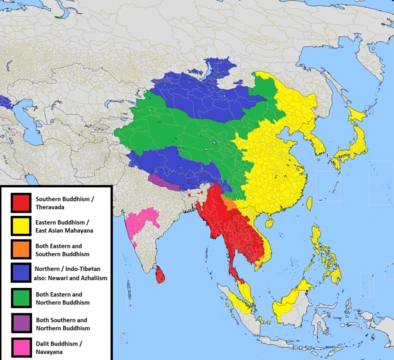
- South Asia, Southeast Asia, East Asia, Russia
Lore & Background
Buddhist temples vary in architecture and structure from region to region, typically consisting not only of buildings but also the surrounding environment. They are designed to symbolize five elements: fire, air, water, earth, and void (space). In India, early temple design was influenced by the idea of a place of worship as a representation of the universe, with one tall temple often centrally located and surrounded by smaller temples and walls, representing a center surrounded by oceans, lesser mountains, and a huge wall. A Chaitya, or Chaitya hall, refers to a shrine, sanctuary, temple, or prayer hall, most commonly in Buddhism, where it denotes a space with a stupa and a rounded apse at the end opposite the entrance, with a high roof of rounded profile. Many early Chaitya were rock-cut, as seen at Karla Caves or Ajanta. Some of the earliest free-standing temples may have been of a circular type, such as the Mahabodhi Temple, whose current structure dates to the 5th–6th centuries CE, with Ashoka credited only with an earlier shrine at the site to protect the Bodhi tree under which the Buddha found enlightenment.
Reader's Guide
Buddhist temples hold significant historical and cultural importance across Asia and beyond. In Indonesia, Buddhism is the second oldest religion after Hinduism, with the oldest Buddhist archaeological site being the Batujaya stupas complex in West Java, with relics dating from the 2nd to the 12th century. The Indonesian archipelago witnessed powerful Buddhist empires such as the Sailendra dynasty, Mataram, and Srivijaya, and produced notable heritage sites like the 8th-century Borobudur mandala monument and Sewu temple. In Japan, Buddhist temples typically include a Main Hall and often feature a chinjusha, a Shinto shrine devoted to the temple's kami, reflecting the coexistence of Buddhism with Shinto. In Thailand, temples known as wat consist of two parts: the Phutthawat, dedicated to Buddha, and the Sangkhawat, dedicated to the Sangha monastic community. Sri Lankan temples, called Pansala or Viharaya, commonly include a Stupa, Bo Tree, and temple buildings, and house the oldest living human-planted Bodhi tree, Jaya Sri Maha Bodhi, as well as some of the largest stupas in the world. In Russia, early Buryat and Kalmyk temples such as khuruls, dugans, and datsans were built with Russian masons and carpenters, showing influence from Russian church architecture, with cruciform plans and vestibules designed to cut off cold air. Since the second half of the 19th century, temples in Russia have been constructed in a square plan as stepped pyramids with Chinese-type roofs with curved corners.
Did You Know?
- Buddhist temples are designed to symbolize five elements: fire, air, water, earth, and void (space).
- The oldest Buddhist archaeological site in Indonesia is the Batujaya stupas complex in Karawang, West Java, generally dated to the 5th–7th centuries CE.
- In Thailand, a wat consists of two parts: the Phutthawat (dedicated to Buddha) and the Sangkhawat (dedicated to the Sangha monastic community).
- Sri Lanka has the oldest living human-planted Bodhi tree in the world, Jaya Sri Maha Bodhi, located in a Buddhist temple.
Architecture & Cosmological Symbolism
Buddhist temples serve as sacred spaces of worship for followers of the faith, known by a variety of names across cultures—vihara, chaitya, stupa, wat, khurul, and pagoda—reflecting the linguistic diversity of the regions where they stand. At their conceptual core, these structures embody the idea of a Buddha's pure realm, crafted to evoke both inner tranquility and outer serenity in those who enter. The architectural vocabulary of Buddhist temples draws on a shared set of design principles, yet produces distinct stylistic expressions across South Asia, Southeast Asia, and East Asia. Beyond the buildings themselves, the surrounding landscape is considered an integral part of the temple complex. The overall design is meant to symbolize the five fundamental elements: fire, air, water, earth, and void or space. This elemental symbolism gives the temple a cosmological dimension, transforming it from a mere building into a microcosm of the natural world.
India: Origins & the Chaitya Tradition
The earliest Buddhist temple traditions in India were shaped by the idea that a worship space should mirror the universe. Temple complexes typically placed one tall central structure surrounded by smaller temples and enclosing walls, evoking a cosmography of oceans, lesser mountains, and a great boundary. The chaitya, or prayer hall, is a defining form: a space housing a stupa with a rounded apse at the far end opposite the entrance, crowned by a high, rounded-profile roof. Strictly, the chaitya refers to the stupa itself, though the term commonly extends to the entire hall. Many of the earliest examples were carved directly into rock, as at the Karla Caves and Ajanta. Some of the oldest free-standing temples appear to have been circular. Ashoka erected the Mahabodhi Temple at Bodh Gaya around 250 BCE as a circular shelter for the Bodhi tree where the Buddha attained enlightenment. The Bairat Temple, also round, survives only in archaeological remains. Reliefs on the stupa railings at Bhārhut and Sanchi, dating to roughly 100 BCE, depict these early circular forms, and an almost intact sandstone slab called the Diamond Throne, placed by Ashoka at the base of the Bodhi tree, endures from that era. Circular designs also appear in later rock-hewn caves such as Tulja and Guntupalli.
Southeast Asia: Indonesia & Thailand
Buddhism reached the Indonesian archipelago from India around the second century, becoming the second oldest religion in the country after Hinduism. Its history is deeply intertwined with Hinduism, as Indian-influenced empires rose in the same period. The Batujaya stupas complex in Karawang, West Java, is considered the oldest Buddhist archaeological site, with relics spanning from the second to the twelfth century. Significant Buddhist sites also emerged in Sumatra and in Central and East Java. Powerful empires such as the Sailendra dynasty, Mataram, and Srivijaya shaped the region's spiritual landscape, and the seventh-century Chinese monk I-tsing recorded the maritime power of Srivijaya during his pilgrimage to India. Among the most remarkable survivals are the eighth-century Borobudur mandala monument and Sewu temple in Central Java. During the Kediri, Singhasari, and Majapahit eras, Buddhism—called Dharma ri Kasogatan—was an official religion alongside Hinduism, and the national motto Bhinneka Tunggal Ika promoted harmony between the two faiths. Classical Javanese Buddhist art includes the Prajnaparamita statue and figures at Mendut temple. In Thailand, temples are called wat, from the Pāḷi vāṭa meaning enclosure, and typically consist of two zones: the Phutthawat, dedicated to the Buddha, and the Sangkhawat, dedicated to the monastic community.
Japan, Sri Lanka & Russia
In Japan, Buddhist temples typically center on a Main Hall and often include a chinjusha, a Shinto shrine devoted to the temple's kami, reflecting the long coexistence of Buddhism and Shinto. In the eighth century, Buddhism became the state religion, prompting the construction of temples across the country. The highest concentration of important temples is found in the Kansai region, particularly Nara and Kyoto. In Sri Lanka, temples are known as Pansala or Viharaya in Sinhalese, and commonly feature a stupa, a Bo Tree, and temple buildings. The country is home to the oldest living human-planted Bodhi Tree in the world, the Jaya Sri Maha Bodhi, as well as some of the largest stupas globally, including Ruwanwelisaya, Jetavanaramaya, and Abhayagiri vihāra. In Russia, the first Buryat and Kalmyk wooden and stone temples—called khuruls, dugans, and datsans—were constructed with the involvement of Russian masons and carpenters, blending Central Asian Buddhist traditions with local building practices.
Frequently Asked Questions
What is a Buddhist temple?
A Buddhist temple is a dedicated space where followers of Buddhism gather to worship and practice, often doubling as a monastery for monastic life. It goes by many regional names, including vihara, chaitya, stupa, wat, khurul, and pagoda.
What does a Buddhist temple symbolize?
These structures are meant to embody the pure environment of a Buddha and represent the five classical elements: fire, air, water, earth, and void. They are designed to evoke a sense of both inner tranquility and outer serenity for anyone who enters.
In which regions can you find Buddhist temples?
Buddhist temples are widespread across South Asia, Southeast Asia, and East Asia, with additional presence in Russia. Each region developed its own distinctive architectural style while sharing the common purpose of worship and meditation.
What architectural principles guide the design of a Buddhist temple?
Builders follow established principles of Buddhist architecture aimed at inspiring peace in both the mind and the surrounding space. The resulting styles vary regionally but all trace back to these shared design guidelines.
What field of study does the Buddhist temple belong to?
The Buddhist temple falls under the category of religious architecture. It is recognized primarily as a place of worship for Buddhists and as a physical symbol of peace and the five elements.
More in Buddhist Traditions 1-21
Spotted an error? Know more?
This is a living reference — every entry is fact-audited, and reader corrections feed straight into our audit queue. Suggest an edit · See this site's audit record