Buddhism in the West
Buddhism's spread and adaptation in Western societies.

Buddhism in the West broadly encompasses the knowledge and practice of Buddhism outside of Asia, in the Western world. Occasional intersections between Western civilization and the Buddhist world have been occurring for thousands of years, beginning with Greek colonies in India after Alexander the Great's conquest in the 4th century BCE. The first Westerners to become Buddhists were Greeks who settled in Bactria and India during the Hellenistic period, and their patronage led to Greco-Buddhism and Greco-Buddhist art.
- first contact
- Alexander the Great's conquest of the Indus Valley (modern Pakistan)
Lore & Background
The first contact between Western culture and Buddhist culture occurred during Alexander the Great's conquest of the Indus Valley region. After his conquest, Greek colonists established cities and kingdoms in Bactria and India where Buddhism was thriving, leading to Greco-Buddhism and Greco-Buddhist art, especially in the Gandharan civilization. This art was a syncretic development, blending Greek and Indian influences, rather than a one-way teaching relationship. The Indo-Greek king Menander I adopted Buddhism, as recorded in the Milinda Panha, and a Greek elder monk named Mahadharmaraksita is said to have led a large number of Buddhist monks from a Greek city to Sri Lanka—traditionally given as 30,000, a hyperbolic figure rather than a precise historical fact.
Reader's Guide
Buddhism in the West represents a long history of cross-cultural exchange, from ancient Greek encounters to modern immigration and globalization. The early Greco-Buddhist period produced unique art and philosophical parallels, such as Pyrrhonism's similarity to Buddhist teachings. During the early modern era, Jesuit missionaries like Ippolito Desideri and Matteo Ricci sent detailed accounts of Buddhist practices, while colonial encounters in Sri Lanka led to debates and polemics. In the 20th century, factors such as immigration, the decline of Christianity, and increased Western interest led to the establishment of Buddhist schools in all major Western countries, though Buddhists remain a small minority in the United States (1% in 2024), Europe (0.3% in 2020), Australia (2.4% in 2016), and New Zealand (1.5% in 2013).
Did You Know?
- The first Westerners to become Buddhists were Greeks who settled in Bactria and India during the Hellenistic period.
- The Indo-Greek king Menander I is a main character in the Buddhist scripture Milinda Panha, which states he adopted Buddhism.
- A marble statue of a Buddha was uncovered in Berenice, Egypt, in March 2022 at a temple dedicated to the goddess Isis.
- The early Christian church father Clement of Alexandria (died AD 215) mentioned Buddha, whom he said Indians honor as a god.
The Architecture of Division
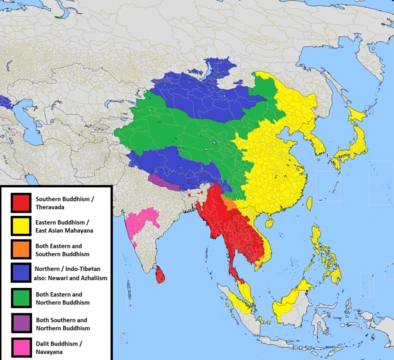
The splintering of Buddhism into distinct schools is not a modern phenomenon but one stretching back to the very first schism in the tradition's history. What began as a single stream has, over centuries, branched into what some scholars estimate at thousands of sects, sub-sects, movements, and worldviews. The criteria for drawing these boundaries are themselves contested: geography, historical rupture, sectarian allegiance, and divergent readings of scripture all play a role. In Western academia, the most familiar framework is a threefold split—Theravāda, Mahāyāna, and Vajrayāna—though a simpler two-group model (Theravāda versus Mahāyāna) also persists in English-language scholarship. A cultural-geographical lens offers yet another map, grouping traditions as Southern, Northern or Himalayan, and East Asian Buddhism. Beyond these established categories, modern-era new religious movements, from the Indian Dalit Buddhist movement to various Japanese new religions, continue to expand the family tree.
Doctrinal Continuity and Divergence
Despite the sheer number of Buddhist lineages, certain core teachings appear remarkably stable across schools. The four noble truths, along with the principles of karma and rebirth, form a doctrinal bedrock that most traditions share. Yet other questions generate far less consensus. How practitioners understand the very nature of the Buddha, for instance, can differ dramatically from one school to the next. The scriptural canons themselves are another major point of divergence: Theravāda communities regard the Pali Canon as their authoritative textual collection, while East Asian Mahāyāna traditions draw on the Chinese Buddhist Canon and its Mahāyāna sutras—texts that Theravāda schools do not consider canonical. Vajrayāna practitioners, meanwhile, center their study on the Kanjur and Tenjur, supplemented by extensive tantric materials. Even the monastic ordination traditions reflect these splits, with three distinct Vinaya lineages corresponding to the three major branches: Theravāda Vinaya, the Dharmaguptaka Vinaya for East Asian Mahāyāna, and the Mūlasarvāstivāda Vinaya for Tibetan Buddhism.
The Three Great Vehicles in Practice
Theravāda, often rendered as 'the Teaching of the Elders,' anchors itself in Sri Lanka and Southeast Asia, where Pali remains the sacred and scholarly language. Its practitioners study the Pali Canon and related literature, and the tradition is sometimes linked to the conservative Nikaya schools of early India that declined to incorporate Mahāyāna sutras into their scriptural collections. East Asian Mahāyāna, by contrast, took root during the Han Dynasty and spread through China, Korea, Japan, and Vietnam. It encompasses an enormous range of practices, from the meditation-centered Zen (Chan) lineages to the devotional Pure Land sects, all drawing on the Chinese Buddhist Canon. Vajrayāna—also called Tantric or Esoteric Buddhism—dominates Tibet, Bhutan, the Himalayan regions of India and Nepal, Mongolia, Inner Mongolia, and the Russian republics of Buryatia, Kalmykia, and Tuva. Some scholars fold Vajrayāna into the broader Mahāyāna category rather than treating it as a separate vehicle, and its esoteric forms overlap with East Asian traditions such as Shingon and Mikkyō.
The One-Vehicle Ideal and Terminological Confusion
One of the most persistent challenges in describing Buddhism's diversity is the terminology itself. Scholars and practitioners divide the tradition by geographic, historical, or philosophical criteria rather than by the adherents' own self-identification, and the same term can carry different meanings in different contexts. 'Eastern Buddhism,' for example, sometimes refers specifically to East Asian traditions and sometimes to all traditional forms of Buddhism as distinct from Westernized expressions. Against this fragmentation, certain Mahāyāna texts—most notably the Lotus Sutra and the Avatamsaka Sutra—proposed a unifying vision called Ekayāna, or the 'one vehicle,' seeking to gather all teachings into a single great way. This idea became foundational to the Tiantai and Tendai sects, which in turn shaped Chán and Zen thought. In Japan, the Lotus Sutra's centrality led Nichiren-lineage communities to replace seated meditation with the chanting of Namu Myoho Renge Kyo, making the sutra's title itself the primary devotional act.
Frequently Asked Questions
What is Buddhism in the West?
It is the umbrella term for Buddhist study and practice carried out outside of Asia, primarily in Western countries. The phenomenon stretches back thousands of years, with early Greek settlers in Bactria and India being among the first non-Asian people to adopt the faith.
When did Buddhism first make contact with the Western world?
The earliest known intersection dates to the 6th century BCE, when Greek colonies already existed in India during the Buddha's lifetime. Alexander the Great's military campaign into India marked a major turning point, and Hellenistic-era Greeks in Bactria became the first documented Western converts.
Who is the most notable early Western Buddhist figure?
Menander I, an Indo-Greek king who ruled from roughly 165/155 BCE to 130 BCE, stands out as the most prominent Western-adjacent patron of Buddhism. His reign helped give rise to Greco-Buddhism and a distinctive fusion of Greek and Buddhist artistic traditions.
How widespread is Buddhism in the West today?
It remains a small but visible presence: about 1% of Americans identified with Buddhism as of 2024, roughly 0.3% of Europeans in 2020, and around 2.4% of Australians in 2016. These figures show a steady, if modest, foothold in Western societies.
Why does Buddhism in the West matter to the broader story of Buddhism?
It demonstrates that Buddhist ideas can travel far beyond their South and East Asian origins and adapt to entirely new cultural contexts. From Hellenistic art to modern Western meditation practices, the Western thread highlights the tradition's capacity for cross-cultural evolution.
More in Buddhist Traditions 1-21
Spotted an error? Know more?
This is a living reference — every entry is fact-audited, and reader corrections feed straight into our audit queue. Suggest an edit · See this site's audit record