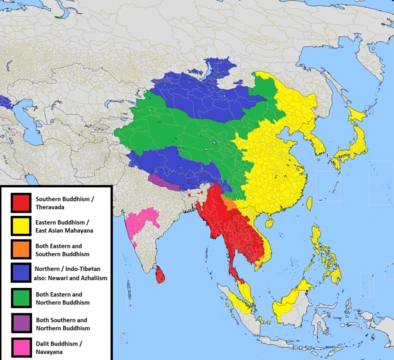
Dzogchen
Tradition aiming at direct experience of the ultimate ground of existence.

Dzogchen (Tibetan: རྫོགས་ཆེན་, Wylie: rdzogs chen 'Great Completion' or 'Great Perfection'), also known as atiyoga (utmost yoga), is a tradition of teachings in Indo-Tibetan Buddhism and Bön aimed at discovering and remaining in the ultimate ground of existence. The goal of Dzogchen is the direct experience of this basis, called rigpa (Sanskrit: vidyā). It emerged during the first dissemination of Buddhism in Tibet, around the 7th to 9th centuries CE, and is considered a Tibetan development by some scholars while drawing upon key ideas from Indian sources.
- field
- Indo-Tibetan Buddhism and Bön
- known_for
- Direct path to realizing the innate wisdom and compassion of the mind through the discovery of rigpa
- origins
- 7th to 9th centuries CE, Tibet
- key_texts
- Eighteen Great Scriptures (Mind Series), All-Creating King, Seventeen Tantras
Lore & Background
Dzogchen emerged during the first dissemination of Buddhism in Tibet, around the 7th to 9th centuries CE. While some scholars, like American Tibetologist David Germano, argue it is a Tibetan Buddhist development, numerous key ideas (such as emptiness and luminosity) can be found in Indian sources like Buddhist tantras and buddha-nature literature. The earliest Dzogchen texts appeared in the 9th century, attributed to Indian masters such as Śrī Siṅgha and Vimalamitra, and are known as the Eighteen Great Scriptures, forming the 'Mind Series' (Semdé). Early Dzogchen was marked by a departure from normative Vajrayāna practices, focusing instead on simple calming contemplations leading to a direct immersion in awareness.
Reader's Guide
During the Tibetan renaissance era (10th to early 12th century), Dzogchen underwent significant development, incorporating new practices and teachings from India. This period saw the emergence of new traditions like the 'Instruction Class series' (Menngagde) and the 'Seminal Heart' (snying thig). The most important scholarly figure in the systematization of these traditions was Longchenpa Rabjampa (1308–1364). Dzogchen is classified into three series: Semdé (Mind Series), Longdé (Space Series), and Menngaggidé (Instruction Series). The path comprises the Base (original state of emptiness, clarity, and compassionate energy), the Path (direct understanding of the mind's pure nature), and the Fruit (realization of one's true nature, leading to non-dual awareness). Practitioners aim for self-liberation, where all experiences are integrated with awareness of one's true nature, potentially culminating in the attainment of a rainbow body at death, symbolizing full Buddhahood. Critics point to tensions between gradual and simultaneous practice, but practitioners argue these approaches cater to different levels of ability.
Did You Know?
- Dzogchen is also known as atiyoga, meaning 'utmost yoga'.
- The earliest Dzogchen texts, the Eighteen Great Scriptures, are attributed to Indian masters like Śrī Siṅgha and Vimalamitra.
- Dzogchen is classified into three series: Semdé (Mind Series), Longdé (Space Series), and Menngaggidé (Instruction Series).
- The attainment of a rainbow body at death is considered a symbol of full Buddhahood in Dzogchen.
The Ultimate Ground and the Aim of Practice
Dzogchen, whose name translates to "Great Perfection" or "Great Completion," is also designated atiyoga, meaning "utmost yoga." At its philosophical core lies the concept of the primordial ground, or gzhi, described as possessing three interwoven qualities: purity (understood as emptiness), spontaneity (linked to luminous clarity, termed lhun grub), and compassion (thugs rje). The entire spiritual architecture of this tradition orients itself toward a single aim: direct knowledge of this foundational basis. That knowledge carries a specific name, rigpa, corresponding to the Sanskrit vidyā. Rather than constructing something new, the practitioner is guided toward recognizing what is already present as the ultimate ground of existence. Across the various Dzogchen systems, numerous spiritual practices are offered as methods for recognizing rigpa and then continuing to abide in that recognition. The tradition thus frames liberation not as attainment of something external but as uncovering, a return to the nature of reality as it inherently is, a discovery rather than an acquisition.
Historical Roots and Institutional Placement
Dzogchen took shape during the Tibetan Empire period and the subsequent Era of Fragmentation, spanning roughly the ninth through eleventh centuries, and it remains a living practice both within Tibet and across the globe today. Within the Nyingma school of Tibetan Buddhism and the Yundrung Bon tradition, it occupies the position of the highest and most definitive path among the nine vehicles to liberation. This placement marks it as the culminating expression of their entire soteriological framework, the apex toward which all other paths point. Beyond these two primary institutional homes, Dzogchen teachings are also found, though to a lesser degree, in the Kagyu, Sakya, and Gelug schools. The Wylie transliteration rdzogs chen and the alternative designation atiyoga signal its claim to the most complete and direct approach within Indo-Tibetan Buddhism. Its endurance from the medieval Tibetan period to present-day global practice underscores a continuity of transmission spanning well over a millennium, carried through successive lineages and geographic contexts.
The Cosmic Origin Narrative
The Nyingma tradition traces Dzogchen's ultimate source to Samantabhadra, identified as the first Buddha to attain awakening and simultaneously a symbol for the awakened nature inherent in every being, the Dharmakāya. This event is placed countless eons before the formation of our own universe. Samantabhadra's millions of manifestations are said to teach across trillions of world systems, including ours. In the Sambhoghakaya realm, he manifests as Vajrasattva, or sometimes Vairocana Jñanasaghara, within the supreme buddhafield of Ghanavyūhakaniṣṭha, from which all other Buddhas and buddhafields emanate. There, Vairocana instructs bodhisattvas in Dzogchen. The tradition further holds that nirmanakaya emanations carry the teaching into thirteen world systems and our own. In our universe specifically, the transmission is attributed to twelve nirmāṇakāya buddhas, emanations of Vajradhara, who assumed various forms across different realms, each revealing particular Dzogchen teachings to specific gatherings of beings at distinct points in cosmic time.
Garab Dorje and the Human Lineage
The Nyingma account identifies Garab Dorje, known in Sanskrit as Prahevajra or Vajraprahe, as the first human lineage holder of Dzogchen. He is portrayed as an awakened being who received instruction from Vajrapani in the deva realms before choosing to incarnate on earth specifically to teach. Dudjom Rinpoche describes him as a great Buddhist adept from Oddiyana, a region that may correspond to Pakistan's Swat Valley, who transmitted Dzogchen to dakinis. His chronological placement is bracketed by the fact that he taught Mañjuśrīmitra, a scholar associated with Nalanda University, situating Garab Dorje no earlier than the fourth or fifth centuries CE. Among his numerous disciples mentioned in Dzogchen literature are King Dhahenatalo, Prince Thuwo Rajahati, Princess Barani, and Lui Gvalpo Gawo. Mañjuśrīmitra is credited with dividing the Dzogchen doctrine, marking a pivotal moment in the systematization of the tradition for subsequent generations of practitioners.
Frequently Asked Questions
What is Dzogchen?
Dzogchen, meaning 'Great Perfection' or 'Great Completion,' is a lineage of teachings within Indo-Tibetan Buddhism and Bön that points practitioners directly toward recognizing the ultimate ground of existence. It is also called atiyoga, or 'utmost yoga,' to mark its position as the highest stage of practice.
What is rigpa and why does it matter in Dzogchen?
Rigpa is the term Dzogchen uses for the innate, luminous awareness that constitutes the true nature of mind. The entire practice is oriented around directly experiencing this awareness rather than building it up through gradual conceptual analysis.
When and where did Dzogchen originate?
The tradition took shape in Tibet during the first wave of Buddhist transmission, roughly between the 7th and 9th centuries CE. Some scholars treat it as a distinctly Tibetan elaboration, though it draws on concepts traceable to Indian yogic sources.
What are the main Dzogchen texts?
The core literature includes the Eighteen Great Scriptures (the Mind Series), the All-Creating King, and the Seventeen Tantras. These collections frame the three principal cycles—Mind, Space, and Secret—through which the teachings are organized.
How does Dzogchen differ from other Buddhist paths?
Rather than relying on lengthy stages of conceptual analysis or ritual construction, Dzogchen emphasizes a direct, non-dual recognition of mind's already-present nature. It is often described as the 'direct path' because it asks the practitioner to simply rest in rigpa without adding or subtracting anything.
More in Buddhist Traditions 1-21
Spotted an error? Know more?
This is a living reference — every entry is fact-audited, and reader corrections feed straight into our audit queue. Suggest an edit · See this site's audit record