Frequently Asked Questions
The most-asked questions about buddhist traditions.
What are Buddhist traditions?
Buddhist traditions refer to the many schools and lineages of practice that grew out of the teachings of Siddhartha Gautama over roughly 2,500 years. They encompass a wide spectrum of philosophical, meditative, and ritual approaches found across Asia and increasingly worldwide.
Who is the Buddha?
The Buddha was Siddhartha Gautama, a prince from the region of modern-day Nepal and India who gave up his royal life and attained awakening through meditation around the 5th century BCE. Every major tradition regards him as the founding teacher whose insights underpin the entire path.
What are the three main branches of Buddhism?
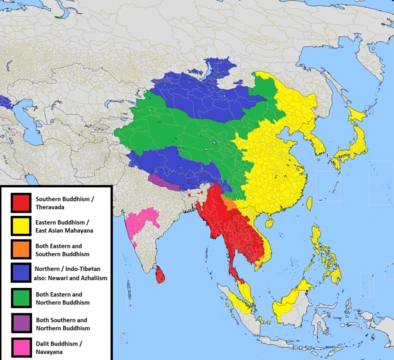
The three most commonly cited branches are Theravada (dominant in Sri Lanka, Thailand, Myanmar, Cambodia, and Laos), Mahayana (prevalent in China, Japan, Korea, and Vietnam), and Vajrayana (central to Tibetan, Mongolian, and certain Japanese lineages). Each emphasizes different scriptures, meditation methods, and philosophical frameworks while sharing a common root in the Buddha's core teachings.
What are the Four Noble Truths?
They are the Buddha's first discourse: suffering (dukkha) is real, it arises from craving and ignorance, it can come to an end, and there is a practical path leading to that end. They function less as fixed dogmas and more as a diagnostic framework for understanding the human condition.
What is the Noble Eightfold Path?
It is the practical 'middle way' the Buddha outlined, consisting of right view, intention, speech, action, livelihood, effort, mindfulness, and concentration. The eight factors are traditionally grouped into three training areas: ethical conduct, mental discipline, and wisdom.
How do monastic and lay practice differ?
Monastics take a full set of precepts (often 227 in the Theravada Vinaya) and devote their lives to intensive study and meditation, while lay followers typically observe five or ten precepts and weave practice into family and work life. Both paths are regarded as valid routes toward liberation in every major tradition.
What is a Bodhisattva?
In Mahayana and Vajrayana, a Bodhisattva is one who vows to attain full awakening not merely for personal liberation but in order to benefit all sentient beings. Figures such as Avalokiteshvara (embodying compassion) and Manjushri (embodying wisdom) are the most widely venerated examples across East Asian practice.
What are the main sacred texts?
The Pali Canon (Tipitaka) is the oldest written collection and the primary scripture of Theravada; Mahayana adds thousands of sutras including the Heart, Diamond, and Lotus; Vajrayana further incorporates tantric texts and extensive commentarial literature. The exact canon a community follows varies by tradition and region.
What is Nirvana or Enlightenment?
It is the extinguishing of greed, hatred, and delusion—the root causes of suffering—resulting in a state of unconditioned peace that transcends the cycle of birth and death. Different traditions use different metaphors (unbinding, awakening, buddhahood) but point to the same fundamental transformation of mind.
Where and when did Buddhism spread?
It originated in the Gangetic plain of South Asia around the 5th–4th century BCE, reached Sri Lanka and mainland Southeast Asia by the 3rd century BCE, entered China by the 1st century CE, and subsequently shaped Japan, Korea, Tibet, and Mongolia over the following centuries. In the modern era it has become a global phenomenon with substantial communities in the West.